Why new-growth symptoms are different
Plants prioritise the youngest leaves and protect them from systemic shortages by cannibalising the older ones. When water, nitrogen, magnesium, or potassium runs short, the plant strips chlorophyll and proteins from old lower leaves, ships the nutrients up to the growth tip, and the new leaves come in healthy while the old ones yellow and drop. This is why almost every classic deficiency and over-/under-watering symptom appears on lower, older leaves first.
When new leaves themselves are visibly wrong, the plant has either run out of old leaves to sacrifice (severe long-term shortage), or the problem is not one the plant can move around — it is something happening directly to the new growth as it forms. The shortlist of causes is therefore much shorter than for old-leaf problems: light at the growth tip, pests living on the meristem, sudden environmental shock, mineral toxicity in the soil, or one of the immobile-nutrient deficiencies (iron, calcium, manganese). For the matching old-growth side of the diagnostic flow, see the leaf damage decoder — most plant problems are best read by comparing what is happening at the top vs the bottom of the plant.
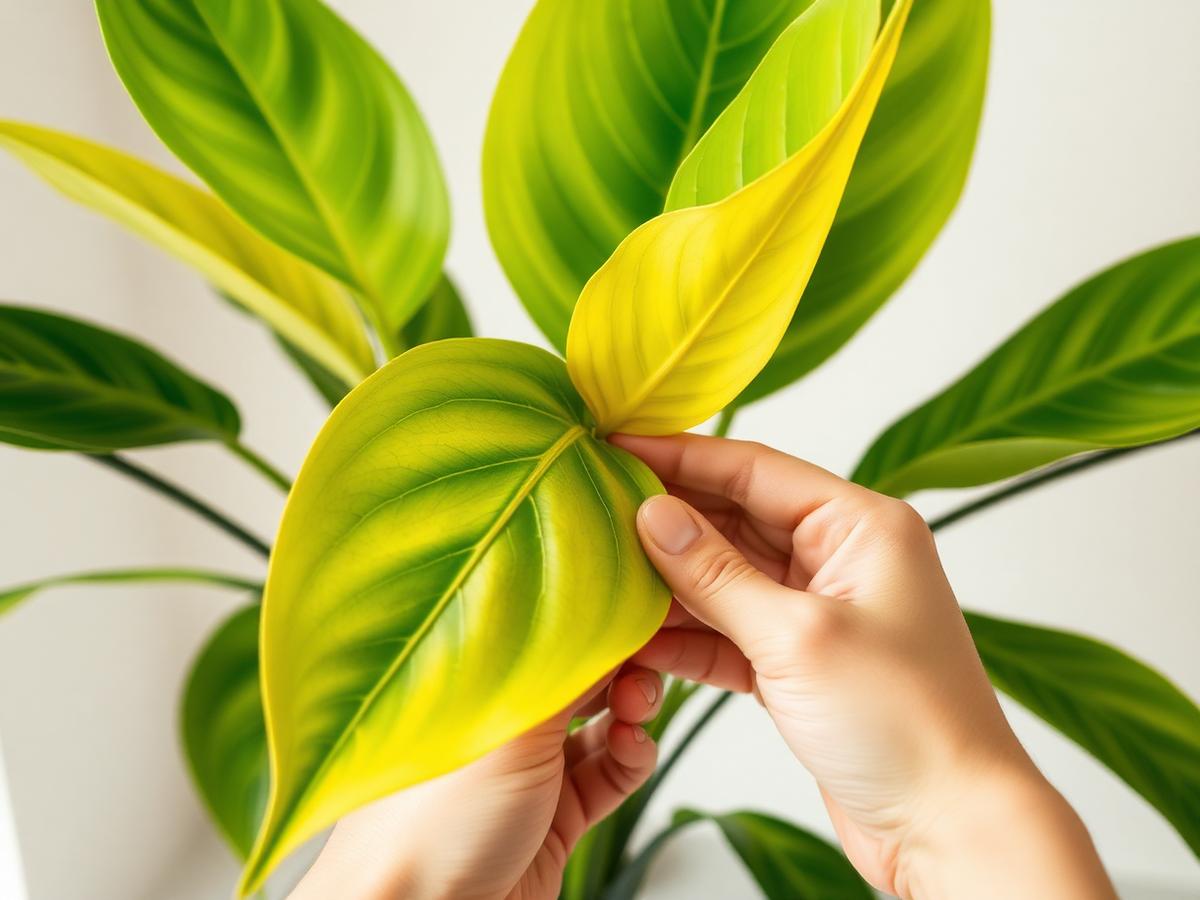
Pale or yellow new leaves
By far the most common new-growth complaint, and almost always one of two causes: light deficit or iron deficiency. The two look similar but separate cleanly under a small inspection.
Light deficit produces uniformly pale, washed-out new leaves with long internodes (the stem gaps between leaves) and weak, thin stems. The whole growth pattern is stretched. The new leaf itself is pale because the plant cannot afford to invest scarce energy in heavy chlorophyll production. Move the plant 30–50 cm closer to a window or add a grow light and the next new leaf comes in larger and greener within 3–4 weeks. Iron deficiency produces interveinal chlorosis on new leaves specifically — yellow tissue between distinctly green veins, in a lacy pattern. The internodes are normal. The cause is usually alkaline tap water (above pH 7.5) blocking iron uptake; switch to filtered or rainwater, repot into fresh slightly-acidic mix, and check that fertiliser includes chelated iron. See the nutrient deficiency chart for the full mobility-rule walkthrough. The seasonal version of this problem — pale new growth specifically after winter — is covered in leggy, pale new growth after winter.
- ·Pale + uniform + long internodes → light deficit. Move closer to the window.
- ·Pale + interveinal pattern + green veins → iron deficiency. Check water and pH.
- ·Pale + small new leaves at the same time → both, often together (low light + slow uptake).
- ·Pale + sudden, after a recent move → shock. Wait 2–3 weeks before changing anything.
Small new leaves
If new leaves come in noticeably smaller than the older leaves on the same plant, the plant is signalling that the conditions producing the old leaves were better than the conditions producing the new ones. The diagnosis hinges on the gap between leaves (the internodes) and the position the smaller leaves appeared.
Light deficit is the most common cause. New leaves are smaller and the internodes between them are longer than they used to be — the plant is stretching toward light it is not finding. Fix the light and the next new leaves return to normal size within 4–6 weeks. Pot-bound roots are the second cause. The plant has run out of soil and the root system cannot supply enough water and nutrients to size up new leaves. Tip the plant out and check — if you see a tight circling spiral with little soil left, repot one size up. Natural acclimation is the benign cause: a plant that came from a high-light greenhouse will produce smaller new leaves indoors for 2–3 cycles before stabilising at the new equilibrium size. See why is my new plant dropping leaves for the wider acclimation flow.
Deformed, hooked, or twisted new leaves
Distorted new growth is the most diagnostic single symptom — it has a short list of causes and they are easy to separate. Hooked, curled, or stunted new tips point at calcium deficiency, which is rare in tap-watered houseplants but common in distilled-water-only setups. Switch to filtered tap or remineralised water and the next leaves come in straight.
Twisted, malformed, scarred new leaves with silvery or bronze patches usually indicate thrips feeding on the meristem — they puncture cells in the bud before the leaf even unfurls, and the leaf opens with permanent damage. Look for tiny dark insects (1–2 mm) at the growth tip, dusty residue on undersides, and silvering on the upper leaf surface. See thrips for the full identification and treatment protocol. Cupped or curled new leaves with no insect signs are most often physical damage from a recent move (the bud knocked against something), or a sudden temperature change (cold draft, hot radiator). Wait one full leaf cycle to confirm the next leaf comes in normal.
- ·Hooked tips, distilled-water-only setup → calcium deficiency. Switch to tap or remineralised water.
- ·Twisted + silvering + dusty undersides → thrips. Inspect the meristem under a loupe.
- ·Cupped or curled + recent move → shock or bud damage. Wait one cycle.
- ·Bumpy raised areas on new leaves → edema; see edema.
- ·Leaves opening already chewed-looking → aphids on the bud. See aphids.
New leaves stuck together or not unfurling
When a new leaf gets stuck mid-unfurl — the cigar-shaped emerging leaf cannot open and tears trying — there are usually two causes and both are urgent if you want to save the leaf. Low humidity is the more common one: the protective sheath dries out before the leaf can open and physically welds itself closed. Calatheas, marantas, and aroids in dry winter air all show this. Mist the unfurling leaf gently a few times a day, raise the room humidity if possible (a humidifier nearby is the simplest fix — see should you mist for what actually works), or wrap the plant in a clear plastic bag for 48 hours to create a microclimate.
Thrips damage during emergence is the second cause and harder to fix — the insects feed on the bud while it is forming, and the leaf comes out already deformed and stuck. If the plant has thrips elsewhere (silvering on upper leaf surfaces, fine dusty residue), the new leaves will continue coming in damaged until the population is suppressed. Treat with insecticidal soap or systemic neem, isolate the plant from your collection, and expect 2–3 leaf cycles before clean new growth returns. The full treatment protocol is in thrips on houseplants.
Crispy, burnt, or scorched new leaves
New leaves are more sensitive to direct sun, hot air, and chemical exposure than mature leaves — they have not yet developed the waxy cuticle that protects older foliage. Sun scorch on new leaves is bleached white or beige patches on the parts of the leaf most exposed to direct light, often after a plant has been moved closer to a window or after a winter-to-spring light increase. The damage is permanent on those leaves but harmless if the new growth pattern continues normally — see bleached leaves for the prevention flow.
Fertiliser burn on new leaves shows as crispy brown tips and edges on the very freshest growth, often after a recent fertilising session. The plant has taken up more salts than it can use; the cells at the leaf extremities desiccate. Flush the pot with three times its volume of plain water and pause feeding for at least a month. Cold draft damage appears as pale, soft, or watery patches on new leaves on the side of the plant facing a window or door, especially after a winter night. Move the plant 30 cm away from the cold source. None of these damages reverse on the affected leaves; recovery is judged by the next batch of new growth.
When the plant has stopped growing entirely
If no new leaves have appeared in 6–8 weeks during the active growth season (March–October in northern Europe), the plant is in stalled growth — distinct from the symptom-on-new-leaves problems above. The five common causes:
- ·Light deficit, severe — the plant cannot generate enough energy to grow at all. Move closer to a window or add a grow light.
- ·Root-bound and starved — soil exhausted, no room left for roots. Repot. See when to repot.
- ·Cold or dim winter conditions — normal dormancy. Resume growth on its own when light and temperature return.
- ·Recent transplant or major move — recovery period of 2–6 weeks before growth resumes. Be patient.
- ·Active root rot — the plant cannot grow new tissue while losing old roots. Tip out and check. See root rot.
How to know recovery is happening
The damaged or deformed new leaves will not recover — like all leaf damage, what is on those leaves is permanent. Recovery is judged by the next batch of new growth, not by any change in the existing damaged leaves. Once the underlying cause is corrected (better light, water-quality switch, pest treatment, repot), expect 2–4 weeks for the next leaf to emerge, and that one tells you whether the fix worked.
If the next new leaf comes in larger, greener, properly-formed, and the right colour for the species, the cause was correctly identified and the plant is on the way back. If the next leaf still has the same problem, either the diagnosis is wrong or the underlying cause has not yet been fully removed (a thrips population, for example, takes 2–3 leaf cycles to suppress). Use the symptom checker at [/diagnose](/diagnose) for a multi-symptom weighted read if the next new leaf still looks off.