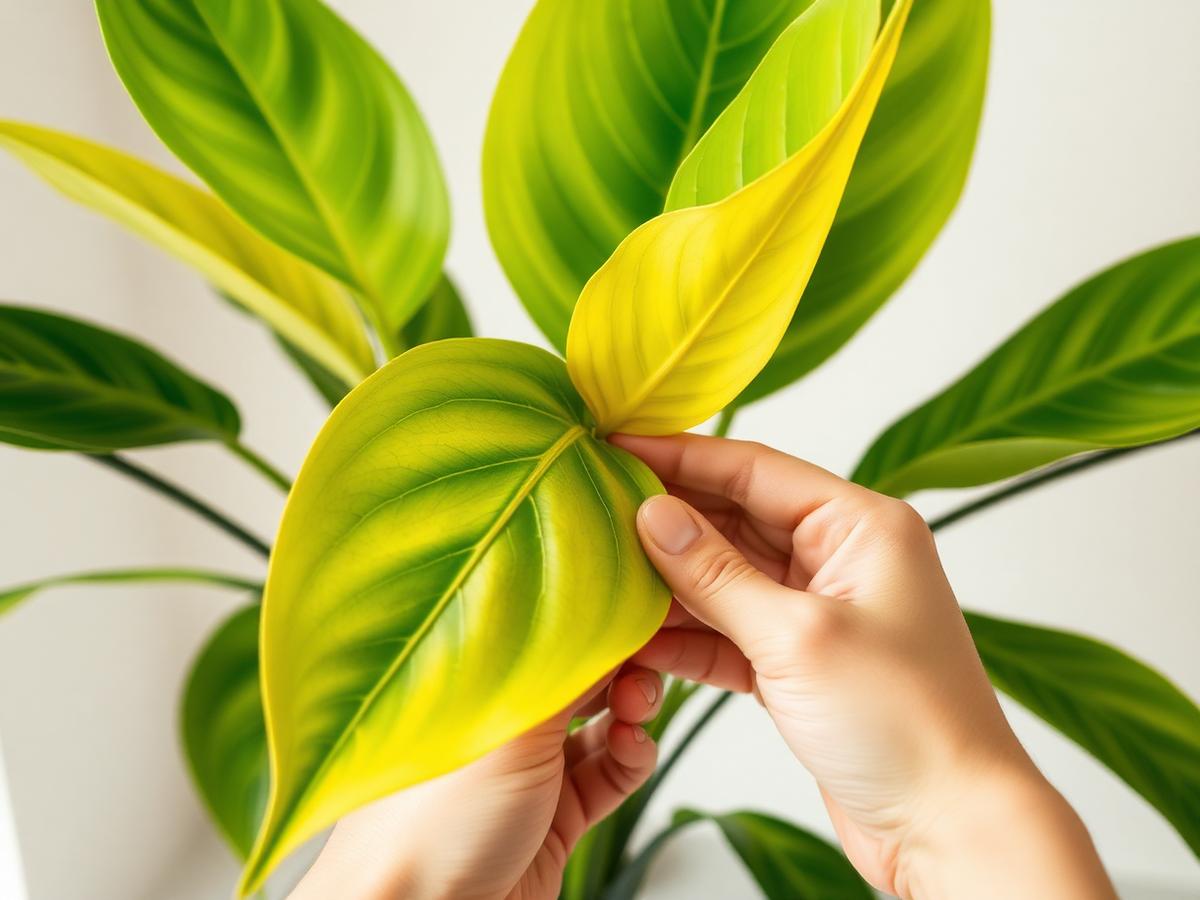
The 60-second triage: colour, pattern, texture
Pick up the affected leaf and ask three questions in order. What colour shift do you see? (Yellow, brown, pale, dark, red-purple, silver-stippled.) Where is the damage? (Tips, edges, between the veins, scattered spots, whole leaf.) What does it feel like? (Crispy, soft, sticky, fuzzy, papery, bumpy.) Most readers stop at the first question — and that is exactly why the same yellow leaf gets diagnosed as overwatering, underwatering, nutrient deficiency, and old age by four different forums.
All three signals together resolve the ambiguity. Yellow alone is meaningless; yellow + soft + lower leaves is overwatering. Yellow + crispy + tips first is underwatering. Yellow + interveinal pattern + new leaves is iron or magnesium deficiency. The rest of this guide unpacks each axis so you can read all three at once.
- 1Read the COLOUR — what shifted away from healthy green.
- 2Read the PATTERN — where on the leaf the damage sits.
- 3Read the TEXTURE — does the tissue feel changed.
- 4Read the AGE — is this old or new growth.
- 5Match the combination to the matrix in the next four sections.
Colour: what each shift signals
Healthy houseplant foliage sits in a narrow chlorophyll-driven green range. Any shift away from that is the plant breaking down its own pigments to recover the nutrients (chlorosis), accumulating stress pigments (anthocyanin reds and purples), or losing tissue outright (necrotic browns and blacks). Reading the specific shift narrows causes by half before you check anything else.
- ·Soft uniform yellow — chlorophyll breakdown from waterlogged roots. Lower leaves first. The single most common diagnosis on the site; see yellow leaves.
- ·Yellow with green veins (interveinal) — nutrient deficiency, usually iron or magnesium. New leaves first means iron; old leaves first means magnesium.
- ·Crispy brown tips — low humidity, fluoride/chlorine in tap water, or salt build-up. See brown leaf tips.
- ·Brown patches with yellow halos — fungal or bacterial leaf-spot disease. See brown spots.
- ·Pale, washed-out new growth — light deficit. Confirm by long internodes and weak stems.
- ·Bleached white or papery patches — direct sun scorch, heat stress, or recent move from low to bright light. See bleached leaves.
- ·Silver stippling on the upper surface — spider mite feeding. Look for fine webs in leaf joints; see spider mites.
- ·Red or purple flushing on stems and undersides — cold stress or anthocyanin reaction to bright light. Common in succulents and some philodendrons; usually cosmetic.
- ·Dark green with curling — too much light, low humidity, or pest pressure (thrips, aphids). See curling leaves.
- ·Black mushy patches — bacterial soft rot or late-stage fungal disease. Isolate the plant and cut to clean tissue.
Pattern: where on the leaf the damage sits
Pattern is the single most diagnostic axis after colour, and the one most readers skip. The same brown colour means radically different things depending on whether it is at the tip, along the edge, in scattered spots, or filling the whole leaf. Pattern reflects which physiological pathway broke.
Tips brown first because they are the farthest point from the root — they suffer first when water transport falters, salts accumulate, or humidity drops. Edges brown first when light or fertiliser is the trigger. Spots are local damage from pathogens or insect feeding. Uniform whole-leaf changes are systemic — water, light, or nutrient.
- ·Tip damage — water transport problem: low humidity, fluoride, salt build-up, or root damage cutting off supply to leaf extremities.
- ·Edge damage (marginal) — fertiliser burn, sun scorch, cold draft, or pot-bound stress. The whole margin browns inward.
- ·Interveinal (between the veins) — nutrient deficiency. The veins stay green because the plant prioritises moving the deficient nutrient out of the spaces between them.
- ·Discrete spots — fungal or bacterial leaf-spot disease, splash damage from cold water, or pest feeding marks.
- ·Whole-leaf uniform change — systemic: water, light, temperature, or chemical (fertiliser flush, tap water). Affects multiple leaves at once.
- ·Damage along major veins — bacterial vein-streak diseases or cold injury that froze the conductive tissue first.
- ·Stippling concentrated near veins or undersides — early pest feeding (spider mites, thrips). Easy to miss until silvering becomes obvious.
Texture: crispy, soft, sticky, fuzzy, bumpy
Texture is the tactile axis and the fastest way to separate two visually-similar problems. A brown spot that is dry and papery is fungal scarring; the same brown spot that is wet and mushy is bacterial. Yellow leaves that are stiff are nutrient-related; yellow leaves that are limp are water-related. Pinch the leaf between thumb and forefinger and ask what changed.
- ·Crispy, papery, dry — water-transport failure. Either the leaf cannot pull water up (low humidity, fluoride, salts) or the roots cannot deliver it (rot, drought, pot-bound).
- ·Soft, limp, water-soaked — overwatering or bacterial soft rot. The cell walls have failed and the leaf has lost turgor.
- ·Sticky to the touch — honeydew from sap-sucking pests. Aphids, mealybugs, scale, and whitefly all secrete it. See sticky residue.
- ·Fuzzy white coating — powdery mildew or, on soil only, harmless saprotrophic mould. See white fuzz and powdery mildew.
- ·Small raised bumps on undersides — edema from a watering-and-humidity imbalance, often confused with pests. See edema.
- ·Hard immobile lumps on stems or veins — scale insects with their protective shell. Scrape one off with a fingernail; it lifts cleanly. See scale.
- ·Cottony tufts in leaf joints — mealybugs. See mealybugs.
- ·Fine webbing between leaves and stems — spider mites. The webs are the late-stage tell; by the time you see them, the population is large.
New growth vs old growth: the most diagnostic axis
Where on the plant the damage appears narrows causes more reliably than any other signal. Old leaves at the bottom of the plant carry months of accumulated stress and are the first to be sacrificed when the plant needs to redirect resources — they tell you about long-running, gentle problems. New leaves at the growth tip are the freshest tissue, untouched by old conditions, so damage there points to something happening right now.
The full triage: damage on lower, older leaves only points at watering, root health, or light deficit (the plant is reabsorbing nutrients from old leaves). Damage on new leaves at the growth tip points at pests, sudden light or temperature shock, recent fertiliser burn, or tap-water mineral build-up. Damage on both typically means a serious systemic problem (advanced rot, severe pest pressure, or cumulative chemical burn) and warrants immediate intervention. See pale, leggy new growth and why is my new plant dropping leaves for the new-growth-specific diagnostic flow.
- ·Old leaves only → watering issue, light deficit, or natural turnover.
- ·New leaves only → pests, light/temperature shock, or chemical/water-quality stress.
- ·All leaves at once → systemic: advanced root rot, infestation, or severe environmental shock.
- ·Specific position (one stem, one side) → localised: light direction, pest cluster, or branch-specific damage.
Holes, tears, and missing chunks
Mechanical damage on indoor plants is rarer than on outdoor plants, but when it happens it is almost always one of four causes. Indoor caterpillars are virtually unheard of in a fully indoor environment, so do not start there.
The four real causes: physical damage from pets, children, or the plant being moved past a doorframe; dropped-leaf scarring where a leaf abscised cleanly and left a small hole at the petiole; monstera-style fenestration which is genetically programmed splitting in mature aroids and is healthy; slugs or earwigs if the plant has spent any time on a balcony, in a greenhouse, or near an open window in summer. See the splits-vs-holes section in the Monstera deliciosa care guide and the why aren't my Monstera leaves splitting piece — fenestrations are growth, not damage.
Genuine pest-chewed holes on a never-outside houseplant are extremely rare. If you see them, inspect the soil at night with a torch — most chewing pests feed after dark. The much more common pest signature is stippling, dusty undersides, sticky residue, or webbing, not chewed-out holes.
Should you cut the damaged leaves off?
The damaged tissue itself will not recover — chlorophyll loss, necrotic spots, and crispy edges are permanent on that leaf. The decision is not about saving the leaf but about whether keeping it helps or harms the plant.
Keep the leaf if more than half of it is still green and functional — even a partial leaf still photosynthesises and contributes net positive energy. Remove it if more than half is dead, if it is mushy or actively rotting (which can spread bacteria), if it is hosting pest eggs, or if a fully yellow lower leaf is being held on by a thread (it will drop on its own — pulling it off cleanly avoids a torn stem). For brown tips specifically, trim along the brown-green border with sharp scissors at a slight angle that mimics the original leaf shape — never cut into the green tissue, which creates a fresh wound the plant must heal.
Always sterilise the blade between plants — wipe with isopropyl alcohol or pass through a flame for two seconds. Bacterial and fungal pathogens are primarily spread by contaminated tools, not air.
- 1More than 50% of the leaf is dead → remove cleanly at the petiole.
- 2Less than 50% damaged but stable → leave it; the plant is still using it.
- 3Mushy, smelly, or actively rotting → remove immediately and isolate the plant.
- 4Brown tips on otherwise healthy leaves → trim the brown along its existing edge.
- 5Yellow leaf hanging on by a thread → snip it; the plant has finished reabsorbing it.
The five most-confused symptom pairs
Half of misdiagnoses on plant forums come from the same handful of look-alike pairs. Memorise these and the rest of the decoder gets faster.
- ·Overwatered vs underwatered: both wilt. Overwatered leaves are soft and yellow; underwatered are crispy and curled. Pot weight is the tiebreaker — see the overwatered vs underwatered walkthrough.
- ·Edema vs scale insects: both look like raised bumps. Edema bumps are uniform-coloured with the leaf surface and rub off as the leaf matures; scale is hard, off-colour, and lifts cleanly with a fingernail.
- ·Powdery mildew vs hard-water residue: both leave white deposits. Mildew spreads outward in patches and feels powdery; mineral residue sits where droplets dried and rinses with water.
- ·Spider mite stippling vs natural variegation: stippling looks like uniform pin-pricks of pale yellow; variegation is patterned and bilaterally consistent. Look at the leaf undersides — mites leave dust and tiny moving dots.
- ·Sun scorch vs fungal leaf-spot: scorch is bleached, dry, and on the most exposed parts of the leaf; fungal spots have defined dark borders, often with a yellow halo, and appear in any leaf position.
When the triage isn't enough — escalating to the diagnoser
If three signals (colour + pattern + texture) plus the new-vs-old test still don't converge on a single cause, the problem is usually multi-factor — water stress on top of a pest infestation, or a nutrient deficiency unmasked by waterlogged roots that block uptake. The site's symptom checker at [/diagnose](/diagnose) takes a multi-symptom selection and ranks the likely causes by weighted match, which handles overlap better than a single-axis read.
Escalate to species-specific guides when the symptom is unusual for the plant — a Monstera dropping new leaves is different from a Calathea dropping new leaves, and the species pages walk the genus-specific failure modes. If symptoms have spread to more than 25% of foliage in a week, isolate the plant from your collection until the cause is identified — both pests and pathogens move between plants on shared trays and tools.