What Nordic winter actually means for plants
At 60° N (Helsinki, Oslo), the sun rises around 09:30 in late December and sets around 15:20 — under 6 hours of daylight. The sun's maximum elevation is 6.5°, which means light enters most apartment windows at a sharp angle and barely penetrates a metre into the room. North-facing flats see almost no direct sun for three months. South-facing flats see direct sun briefly at midday but only at low intensity.
In lux terms: a sunny midday in June at a south window in Stockholm delivers 30,000–50,000 lux. The same window in December delivers 1,500–4,000 lux, and most of that is for fewer than 4 hours per day. A north window in December peaks at 200–800 lux. Most tropical houseplants want 10,000–20,000 lux for several hours daily to grow; they survive at 500–2,000 lux but stop growing and slowly decline. The plants in this guide are the ones that genuinely tolerate the lower bound — see understanding light levels for the full lux reference.
The 12 plants that actually survive
These species tolerate Nordic winter conditions without a grow light, in any window orientation, with normal heating and indoor humidity. Sorted from most-tolerant downward.
- 1ZZ plant (Zamioculcas zamiifolia) — the single best Nordic winter plant. Survives down to 50 lux, stores water in its rhizomes, tolerates being forgotten. See ZZ plant varieties identification.
- 2Snake plant (Dracaena trifasciata) — second-best. Drought-tolerant, low-light-tolerant, even handles cold near a window. See snake plant care guide.
- 3Pothos (Epipremnum aureum) — survives 500 lux happily; the variegated cultivars (Marble Queen, N'Joy) need a bit more. See pothos care guide.
- 4Heartleaf philodendron (Philodendron hederaceum) — same care as pothos; identical winter tolerance.
- 5Parlor palm (Chamaedorea elegans) — Victorian favourite for a reason. Tolerates low light and dry indoor air.
- 6Cast iron plant (Aspidistra elatior) — eponymous toughness; survives north-facing winters with no fuss.
- 7Peace lily (Spathiphyllum) — tolerates 500–1,500 lux, signals thirst dramatically (full collapse, recovers in hours).
- 8Chinese evergreen (Aglaonema) — particularly the dark-leaved cultivars. Pink and red Aglaonemas need more light.
- 9Lucky bamboo (Dracaena sanderiana) — grows in water; minimal light requirement.
- 10Sansevieria cylindrica — same family as snake plant, even more drought-tolerant.
- 11English ivy (Hedera helix) — actually prefers cooler indoor temperatures; thrives near a draughty window.
- 12Spider plant (Chlorophytum comosum) — tolerates north-facing windows; growth slows but does not stop.
The 4 to avoid in a north-facing flat
Some houseplants are sold widely in Nordic plant shops despite being nearly impossible to keep alive in low-light winter conditions without supplementary lighting. The single biggest cause of houseplant deaths in Nordic flats from December to March is owners buying these expecting them to be 'easy'.
- ·Fiddle leaf fig (Ficus lyrata) — wants 10,000+ lux year-round. North-facing winter is fatal. See fiddle leaf fig care guide.
- ·Calathea (most species) — wants 5,000–10,000 lux and 60% humidity. Will limp through winter; rarely thrives. See calathea care guide.
- ·Fittonia (nerve plant) — wants high humidity and at least 2,000 lux. Crisps in heated indoor air with low light.
- ·Most Alocasia — high light, high humidity, warm. Goes dormant or dies back in Nordic winter even at south windows.
What changes for ALL plants — winter care basics
Even the survivor list slows down in Nordic winter. Three care adjustments apply to every houseplant from late October to early March.
- ·Cut watering by 30–50%. Plants transpire less in low light and cool indoor air. Most houseplants want water every 14–21 days in winter rather than every 7–10. See overwatered vs underwatered.
- ·Stop fertilising. Most tropicals are not actively growing; nitrogen goes unused and salts build up in the soil.
- ·Move plants closer to windows, but check for cold drafts. Plants 30 cm from glass on a -15°C night can lose enough heat to drop leaves overnight. A sheet of bubble wrap behind the plant against the window glass insulates without blocking light.
- ·Wipe leaves. Indoor heating dries the air and dust accumulates faster; a thin layer of dust further reduces the light reaching the leaf. See cleaning houseplant leaves.
When to add a grow light
If you want to grow anything beyond the 12-species survivor list, supplementary lighting is the single biggest lever. A 20–40 W full-spectrum LED panel mounted 30 cm above a plant on a 10–12 hour timer adds enough usable light to keep tropical foliage growing through Nordic winter.
Cost: a basic LED panel runs £25–£60 in 2026, plus £5 for a mechanical timer. Power: ~30 W for 10 hours/day = 0.3 kWh/day = roughly £10–£15 per winter season per panel at Nordic electricity prices. The return: plants like fiddle leaf fig, calathea, and rare aroids that would die without it. See do houseplants need a grow light for the full setup guide.
Window orientation matters more than you think
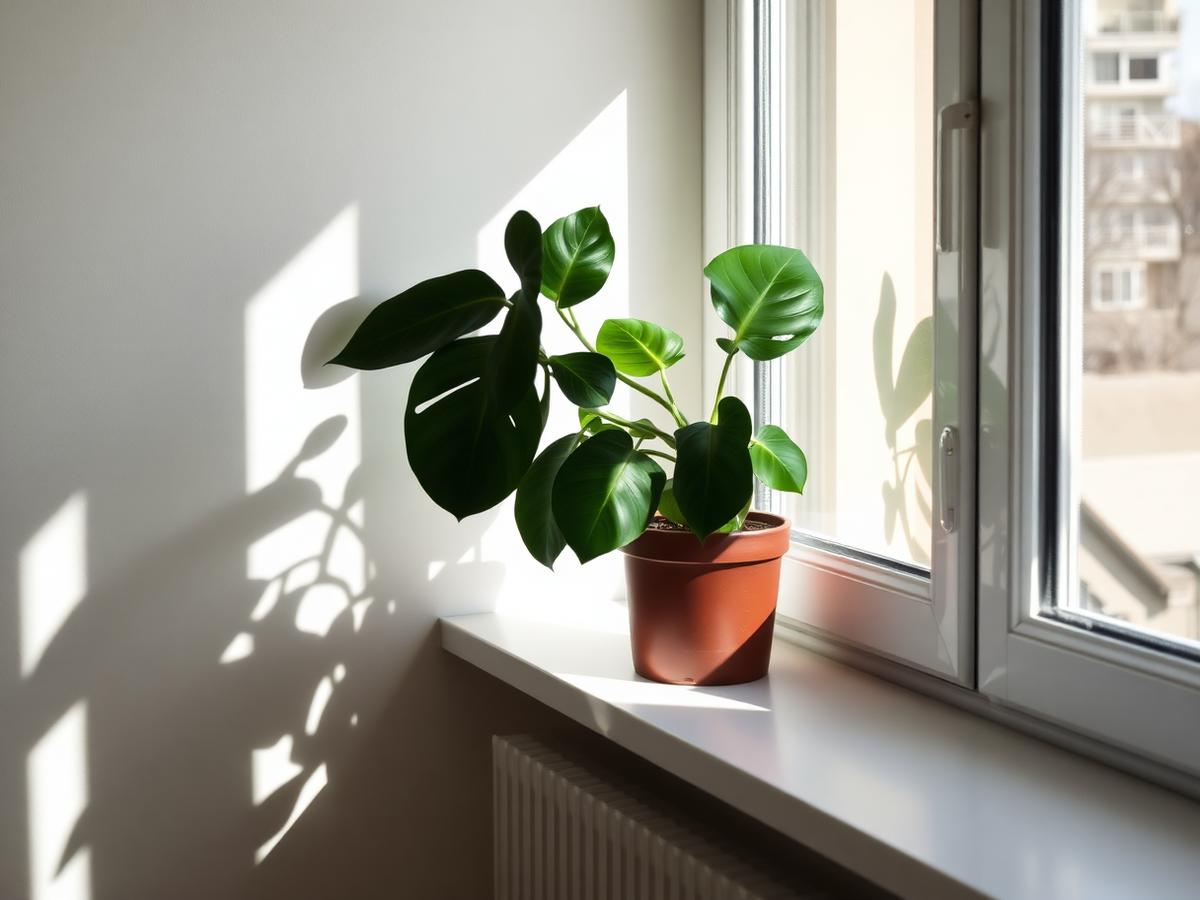
In Nordic winter, the difference between a north-facing and south-facing window is the difference between 200 lux and 4,000 lux at midday — a factor of 20. Even within a flat, moving a plant from a north wall to a south window in November can be the single change that lets it survive.
- ·South-facing: best winter light, even direct sun for 2–4 hours at midday. Suitable for most tropicals if humidity holds.
- ·East-facing: gentle morning sun, decent winter light. Good for Calathea-type plants that want bright but not harsh.
- ·West-facing: similar to east but shifted to afternoon. Slightly warmer near the glass.
- ·North-facing: lowest light, no direct sun all winter. Stick to the 12-species survivor list or add a grow light.
Heated indoor air — the second hidden problem
Nordic apartments run hot — 21–24°C is typical interior temperature in winter, and many older flats with radiators run hotter. The combination of hot air and low outdoor humidity drives indoor relative humidity below 30% — drier than the Sahara on average. This is fine for snake plants and ZZ plants; it is hard on Calathea, ferns, and any plant tagged 'high humidity'.
Three practical responses: cluster plants together (microclimate humidity rises 10–20%), use a humidifier in the room (40–60% target), or accept that high-humidity plants are not the right choice for this environment. Pebble trays do almost nothing; misting raises humidity for minutes only. The full breakdown is in indoor humidity for houseplants in winter and houseplants near radiators.
What spring looks like — the recovery curve
By late February, daylight is returning fast — Stockholm gains roughly 6 minutes of daylight per day from mid-January onward. By 20 March (equinox), the city has 12 hours of daylight again, and by April the angle of incidence has improved enough that a south window receives 15,000+ lux at midday.
Most surviving plants visibly perk up between mid-February and mid-March: new growth resumes, leaves brighten, watering frequency rises. This is when you reset feeding (start fertilising again at half strength), increase watering as the plant tells you to, and consider repotting any plant that needs it. The full spring playbook is in spring watering reset for houseplants and acclimating houseplants to spring light.