What a string of hearts actually is
String of hearts is Ceropegia woodii (sometimes published as *Ceropegia linearis* subsp. *woodii*), a semi-succulent vine in the milkweed family Apocynaceae — the same family as the more familiar Hoya. Its native range is southern Africa: KwaZulu-Natal, eSwatini, and parts of Zimbabwe, where it grows trailing over rocks and through low scrub. The plant is named after John Medley Wood, a Victorian-era curator of the Durban Botanic Gardens who first collected it in 1881.
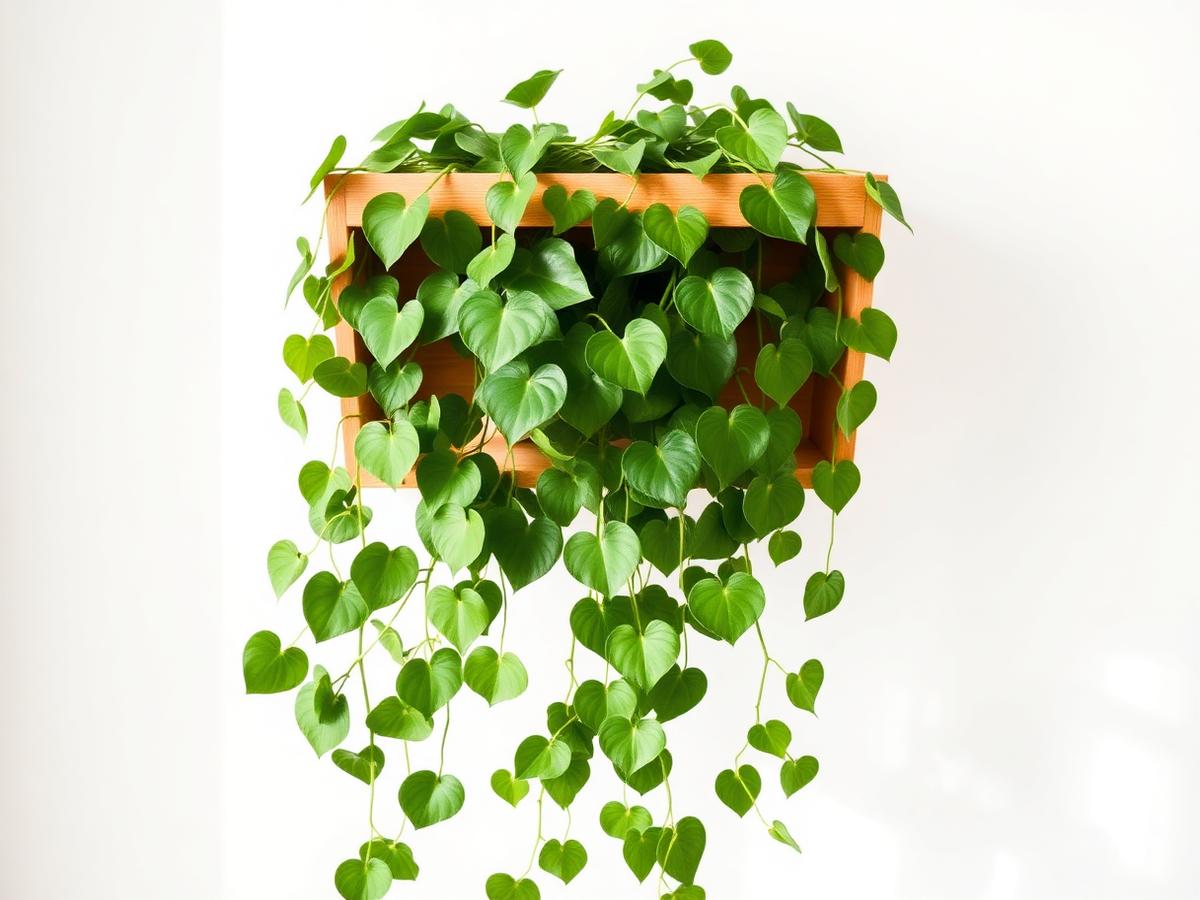
The visible plant — the trailing vine of small heart-shaped silver-marbled leaves — is only half the organism. Below the soil and at the leaf nodes along the vine, Ceropegia produces small pale spherical tubers (also called "beads" or "pearls" in trade) that store water and nutrients. These tubers are why a forgotten string of hearts can come back from a long drought, and they are also the easiest way to propagate the plant — bury one in soil and a new vine emerges within weeks.
Cultivars worth knowing:
- ·Ceropegia woodii (the species type) — silver-grey marbled hearts on dark stems. The standard plant sold under the name.
- ·'Variegata' — pink-and-cream variegation on the heart-shaped leaves. Slightly slower-growing and needs more light to keep its variegation.
- ·'Silver Glory' — denser silver marbling, broader leaves. Often labelled as a different species but is a Ceropegia woodii selection.
- ·'Heartless' / String of needles — Ceropegia linearis (parent species) with thin needle-shaped leaves rather than hearts. Same care as string of hearts.
At a glance
String of hearts is the rare trailing succulent that genuinely thrives indoors in a temperate flat. Most other trailing succulents — string of pearls, string of bananas, sedums — want more direct sun than a north-facing apartment can deliver. Ceropegia woodii sits between the two camps: it tolerates lower light than a true succulent, but it still rots in the watering routine of a tropical houseplant. The right care position is bright indirect light, gritty fast-draining soil, and watering that errs heavily on the dry side.
If you are choosing between string of hearts and string of pearls, choose string of hearts for any flat without a south or west window. String of pearls is dramatically less forgiving in low light.
Light — bright indirect, more than you think
String of hearts wants bright indirect light: about 10,000–20,000 lux, equivalent to an east window all day or one to two metres back from a south window. It tolerates medium light (a north window in summer) but will not produce new growth there — the existing vine just hangs while the plant goes dormant. Direct midday sun through south-facing glass scorches the leaves to a pale washed green; a sheer curtain or a metre of distance fixes that.
The cleanest visual cue is leaf size and spacing. Healthy hearts in good light are 1–1.5 cm across with 2–3 cm gaps between pairs along the vine. Leaves under 1 cm with 4–6 cm gaps and pale colour mean the plant is short of light — common in winter or in a dim corner. The plant is not unhealthy at this point, but it is not putting on new growth either. Move it a metre toward the brightest window, or supplement with a 20 W LED grow light on a 10–12 hour timer 30 cm above the pot. See understanding light levels for indoor plants for the full window-orientation breakdown.
Variegated cultivars need more light than the species type to keep their pink and cream colouring. A 'Variegata' in deep shade slowly reverts to plain silver-marbled green over a season.
Watering — bone dry, then a thorough soak
Treat string of hearts as a succulent, not a tropical. The leaves and tubers store water for weeks; the plant's evolutionary problem is being too wet, not too dry. Water only when the top 5–6 cm of soil is bone dry — typically every 10–14 days in spring and summer, every 3–4 weeks in autumn and winter. The thicker indoor succulent care protocol applies almost exactly here.
When you do water, water thoroughly. Soak the soil until water drains from the bottom of the pot, then drain any saucer within 10 minutes. The deep-soak-then-dry cycle keeps the tubers hydrated and the vine plump. Light frequent sips are the wrong pattern — the soil stays moderately damp for weeks and the tubers rot.
The leaves themselves tell you when watering is overdue: fat firm hearts mean recently watered; slightly soft, slightly puckered hearts mean ready for the next drink; fully wrinkled hearts mean overdue. A plant that has been left dry too long usually recovers fully within 2–5 days of a soak. A plant that has been overwatered may not recover at all.
- ·Hearts plump and firm, soil damp = do not water.
- ·Hearts slightly soft, soil bone dry = water now.
- ·Hearts wrinkled and shrunken, soil bone dry = overdue. Soak thoroughly; recovery within 2–5 days.
- ·Hearts yellow and falling off easily, soil damp = overwatering rot. Stop watering, check tubers, repot in fresh dry mix.
- ·Vine yellowing in winter without other symptoms = normal seasonal pause; not a watering problem.
Soil — gritty, the same as for any succulent
Standard houseplant compost holds far too much water for a string of hearts. The roots and tubers need a fast-draining mix that dries fully between waterings. A reliable recipe: 50% peat-free houseplant compost, 30% perlite or pumice, 20% coarse sand or 1–4 mm grit. Pre-mixed cactus or succulent compost is a perfectly good substitute — read the ingredient list and avoid bags that are mostly peat with token grit.
If you have only generic potting soil, mix it 50/50 with perlite as a minimum. The result drains adequately for string of hearts even without bark or grit. The full breakdown of substrate options is in the best soil mix for houseplants.
Pot — small, and ideally hanging
Use a pot only 1–2 cm wider than the existing root ball. Ceropegia prefers being snug — a small plant in a generous pot has too much wet soil around the tubers, dries unevenly, and rots within months. Terracotta is ideal because it dries faster than plastic or glazed ceramic, but any pot with a drainage hole works.
The plant looks best as a hanging plant, where the vines can trail freely without tangling. A 12–15 cm pot with hanging hooks is a good starting size; a healthy plant fills that pot in 12–18 months and produces 1–2 metres of vine in the first year. If you grow it on a shelf instead, the vines will tangle within months — gentle weekly untangling helps, but the plant still looks tidiest hanging.
Decorative pots without drainage holes are fine as outer cachepots, but plant into a proper inner pot — see pots without drainage holes. Standing water at the base is the fastest way to kill the tubers.
Temperature, humidity, airflow
String of hearts tolerates a wide temperature range — 12–28 °C is comfortable, with a brief tolerance of cooler nights down to about 10 °C. Below that, growth stops and the plant goes dormant; below 5 °C the leaves can develop dark mushy patches that don't recover. Keep the plant away from cold winter window panes — see houseplants near radiators for the radiator/cold-window combo to avoid.
Humidity is not a concern. Ceropegia handles indoor humidity from 30% to 60% without complaint. Misting accomplishes nothing for this plant — and persistent damp on the leaves can cause black spotting. Do not mist string of hearts.
Fertilising — light, infrequent
Feed lightly. A balanced liquid fertiliser at a quarter to half strength once a month from March to September is plenty. Skip feeding from October to February when the plant slows. Over-fertilised string of hearts produce weak floppy growth and lose their characteristic compact leaf spacing — a bigger plant is rarely a better-looking plant in this species. See how often to fertilize houseplants for the wider feeding cadence.
Why is your string of hearts not growing?
This is the most-searched question about Ceropegia woodii, and the answer is almost always one of three things. Walk down the ladder in order:
- 1Not enough light. The dominant cause. New growth in dim conditions slows to almost nothing — the plant maintains the existing vine but does not extend it. Move closer to the brightest window, or supplement with a 20 W LED. New growth typically resumes within 3–4 weeks of the move.
- 2Winter dormancy. Ceropegia goes near-dormant from November to February in northern latitudes. The plant is alive and well, just paused. Resume watering at normal cadence in March and growth picks up within 4–6 weeks.
- 3Root-bound + nutrient depletion. A plant in the same pot for 18+ months with no feeding has exhausted the substrate. Top up with fresh gritty mix, resume monthly feeding, and growth resumes within a month. A full repot into a slightly larger pot is the lasting fix.
- 4Recently moved or repotted. Ceropegia sulks for 2–4 weeks after a move or repot before resuming growth. This is normal; do not water more or feed more during the sulk.
- 5Overwatering rot. A plant that has stopped growing AND looks subtly less full than it did is often rotting at the tubers. Check the soil moisture and the tuber colour — see the rescue protocol below.
Propagation — three methods, all easy
String of hearts is one of the easiest houseplants in the world to propagate. The plant practically multiplies itself, and a single original plant can produce a dozen new ones in a year. Three methods, in order of speed and reliability:
- 1Tuber burial (fastest). Find a small pale tuber along the vine — they form at the leaf nodes. Lay the vine flat on a small pot of fresh gritty mix with the tuber pressed lightly into the surface. Pin in place with a hairpin if needed. Water lightly. New roots and a new vine emerge from the tuber within 2–3 weeks. The most reliable method.
- 2Butterfly cuttings (also called butterfly method). Cut a section of vine into 5 cm pieces, each containing one pair of opposite leaves and the node between them. Lay each piece flat on damp gritty mix with the node pressed into the soil. Roots emerge within 2–3 weeks; a new vine within 4–6 weeks. Higher yield than tuber burial since one vine produces many cuttings.
- 3Water propagation. Cut a 10–15 cm section of vine, strip the lower leaves, and place the bare end in a small glass with 2–3 cm of water. Roots appear within 1–2 weeks. Pot into gritty mix once roots are 2–3 cm long. Slower than soil propagation and the transition from water to soil is the riskiest step. See how to propagate houseplants — water vs soil for the broader water-rooting playbook.
Common problems — quick reference
Most string of hearts complaints fit one of five patterns. The diagnostic shortcut:
- ·Yellow soft leaves falling off easily, soil damp = overwatering rot. Stop watering, check tubers, repot in fresh dry mix. See root rot in houseplants.
- ·Wrinkled shrunken hearts, pot bone-dry = drought. Soak thoroughly; recovery within 2–5 days.
- ·Long bare vines with widely-spaced pale leaves = too little light. Move closer to the brightest window.
- ·Pale washed-out colour with brown patches = direct sun damage. Move back from south-facing glass.
- ·Plant has stopped growing entirely = light, dormancy, root-bound, or rot — see the diagnostic ladder above.
- ·Tangled vines on a shelf = display problem, not plant problem. Hang the plant or untangle weekly.
- ·Sticky residue on leaves = scale insects or mealybugs, uncommon but possible.
Pests
String of hearts is genuinely pest-resistant — the leaves are slightly waxy and the trailing growth keeps most pests from gaining a foothold. The pests that do find them:
- ·Mealybugs — white cottony clumps in leaf axils. Wipe off with a cotton bud dipped in 70% alcohol; treat weekly for three weeks.
- ·Root mealybugs — same insect, but at the tubers. Suspect when a healthy plant suddenly stalls. Tip out and inspect the roots; treat with a systemic insecticide drench.
- ·Spider mites — fine webbing along vines, stippling on leaves. Most common in dry heated rooms in winter. Wipe leaves; treat with insecticidal soap.
- ·Aphids — uncommon but possible on flower buds when the plant blooms. Rinse off with water; treat with insecticidal soap if persistent.
- ·Fungus gnats — drawn to consistently damp soil. Almost always a signal of overwatering. Let the soil dry fully between waterings.
Toxicity — and why string of hearts is the safer trailing plant for cat homes
String of hearts is listed as non-toxic to cats and dogs by the ASPCA. This matters because the visually similar string of pearls (Curio rowleyanus) is mildly toxic and the equally trailing pothos and philodendron are both moderately toxic. If you have a cat that bats at trailing vines and you want a trailing plant, string of hearts is one of the few genuinely safe options.
For the wider catalogue of pet-safe trailing and houseplants, see pet-safe houseplants for cats and dogs and are houseplants toxic to cats and dogs.
Seasonal care in a Nordic apartment
String of hearts has a pronounced seasonal rhythm in northern latitudes — far more than most tropical houseplants. The annual arc:
- ·Spring (Mar–May): Light returns. Resume watering at normal cadence and start light feeding. New growth visible within 2–3 weeks. Best window for repotting and propagation.
- ·Summer (Jun–Aug): Peak growth. The plant produces 20–30 cm of new vine per month in a sunny window. Watering every 10–14 days. Move outside in light shade if you have a balcony.
- ·Autumn (Sep–Oct): Growth slows as light drops. Reduce watering. Stop feeding from October.
- ·Winter (Nov–Feb): Near-dormancy. Watering every 3–4 weeks; some plants take none at all. Skip feeding entirely. Move to the brightest available window or under a grow light. See winter houseplant care for Nordic apartments.